
[contact-form-7 404 "Not Found"]
 Go back to Blog

Fabrice Courdesses
Published on 9 November 2026

Every media buyer eventually faces the same question: Which placements should I use to maximize my video campaign’s performance?
The market already knows how to assess inventory quality, by placement or context.
But this approach misses one major factor: the creative itself. Our research addresses this question by analyzing 15 advertising videos across four clearly defined contexts, using a single performance KPI.
Contextual targeting overlooks what matters most: the creative. The market sells ad inventory based on placement and context, without considering the creative itself.
One number tells the story. When served in the right context, the same video ad can perform 6.2 times better than in the wrong one. Video × context alignment is what makes the difference.
In this article
Context matters. Creative × Context Match matters more.
Consider four contextual targeting segments, with the same placement.
If context alone determined performance, results would remain relatively stable. But they don’t.
Performance gap can reach 6.2× average performance!
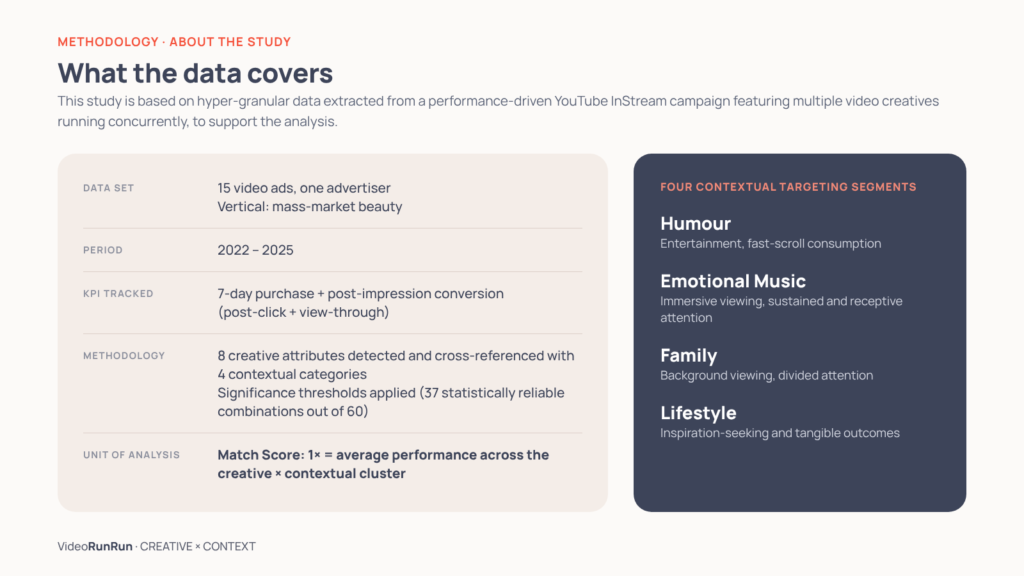
Our study compares 15 creatives across four contextual segments. Each creative × context pairing receives a Match Score, expressing its performance relative to the average.
Let’s dig into two slices of the matrix.
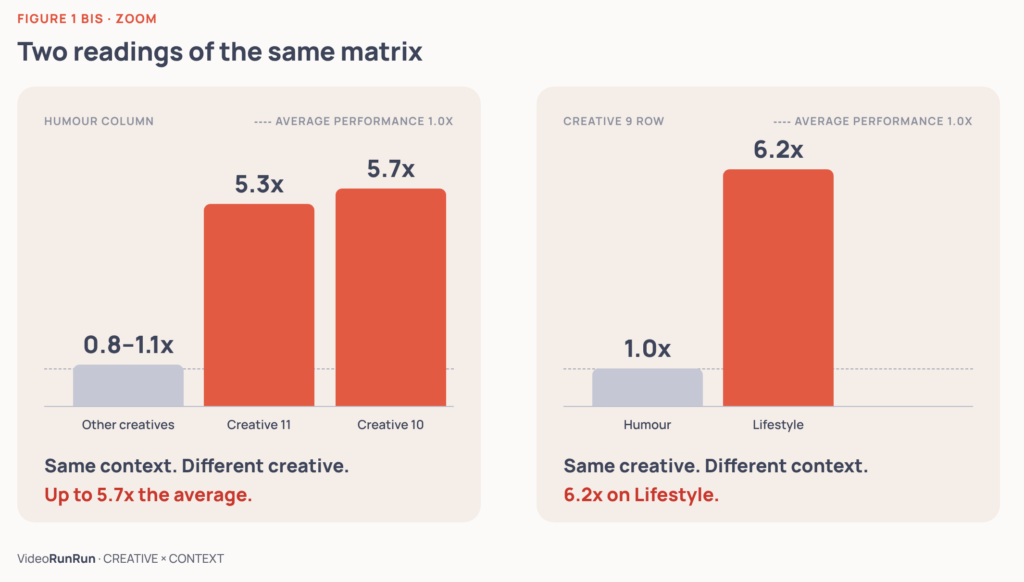
Figure 1 bis · Same context, the creative makes the difference. Same creative, the context does.
Context sets the performance range. The Creative × Context Match determines the outcome.
Before every buy, the question is no longer only “Where will the impression be served?” but also “Which creative will be served there?”
Performance sits at the level of the Creative × Context pairing.
If context alone cannot explain performance, why does one creative work in a particular environment and not another?
The answer lies in its creative attributes.
A video ad combines multiple creative decisions. Its opening hook, editing pace, duration, product presentation and emotional register all contribute to performance.
A creative attribute that works in one contextual segment can become neutral or unfavorable in another.
Take fast-paced editing. It lifts the Match Score in Lifestyle and drags it down in Emotional Music.
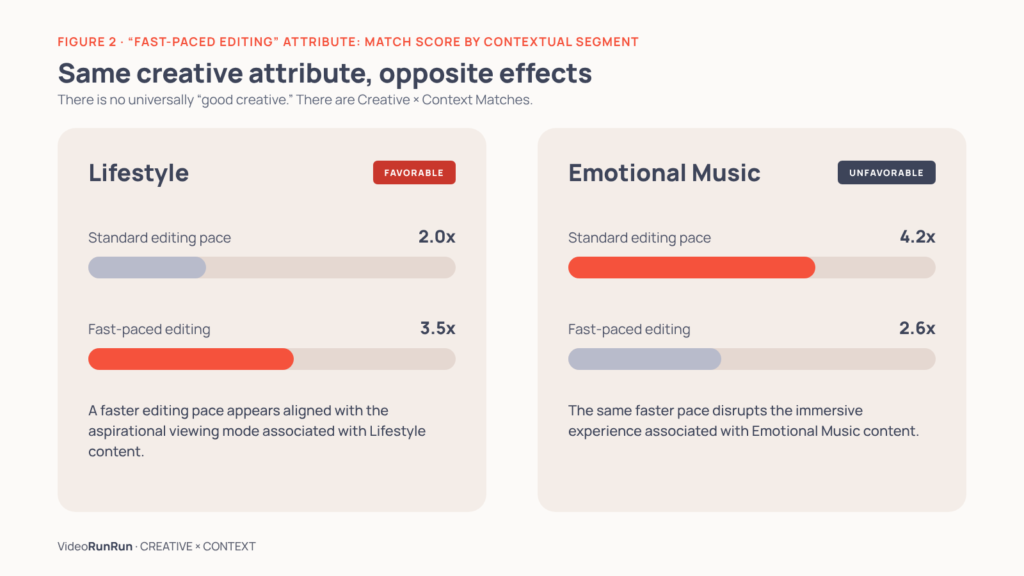
Figure 2. In Lifestyle, fast-paced editing takes the score from 2.0× to 3.5×. In Emotional Music, it pulls it down from 4.2× to 2.6×.
One attribute, two opposite effects.
In Lifestyle, a faster pace matches the aspirational way people watch that content.
In Emotional Music, the same pace breaks the immersion the content builds.
The study applies the same lens to eight creative attributes, grouped into three families.
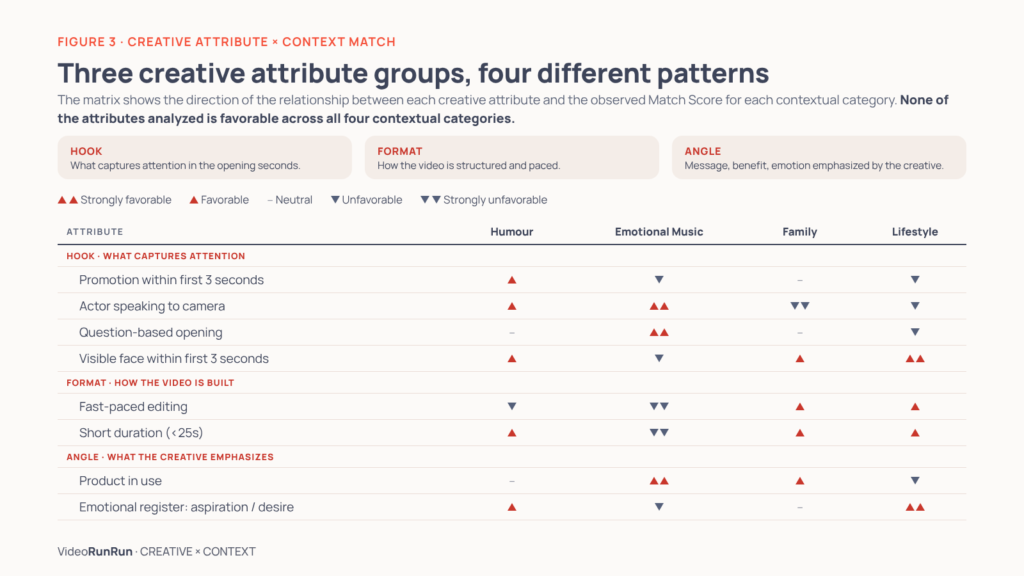
Figure 3. Scan the rows: no attribute is favorable across all four columns. Actor speaking to camera, for instance, is strongly favorable in Emotional Music and strongly unfavorable in Family.
A Creative Attribute × Context correlation only becomes useful once it turns into a briefing rule. Read segment by segment, these patterns add up to an ideal creative profile for each contextual category. :
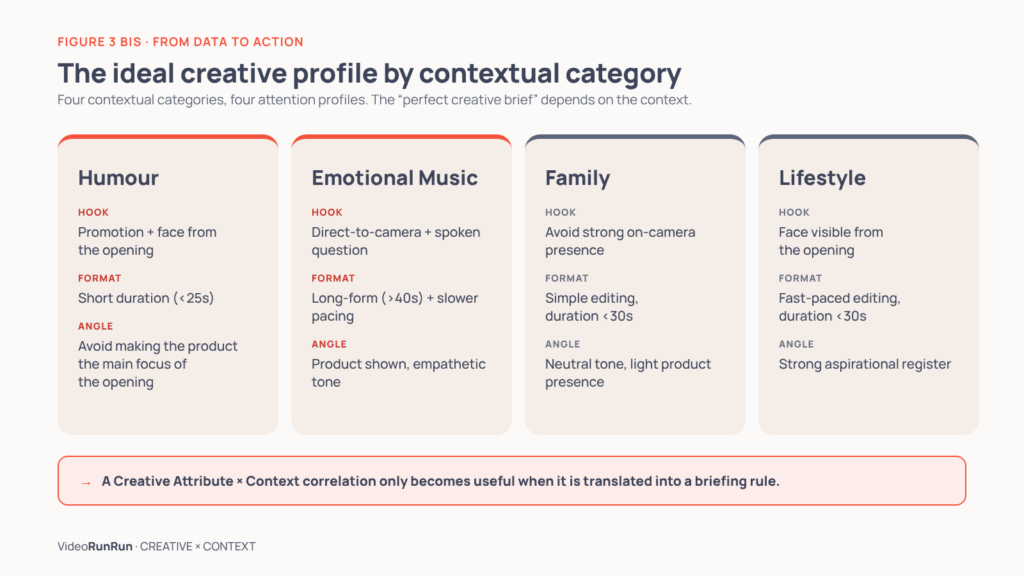
Four contextual categories, four creative briefs: the Hook, Format and Angle to favor in each context.
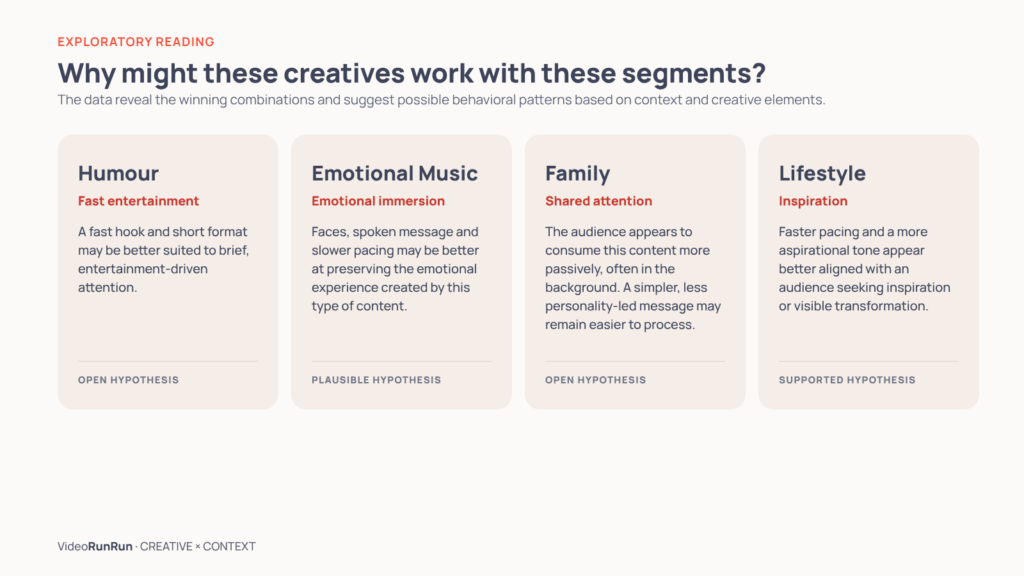
Which leaves one question: why do these profiles win in these segments? The data show the winning combinations. They also hint at how each audience watches, and the study grades each hypothesis by how well the data support it.
Only the Creative × Context combination reveals the true value of inventory
The true value of inventory only emerges when paired with the right type of creative. Yet today, there is no way to assess that match before activation.
Without creative signals, inventory is valued in isolation, rather than dynamically, based on the creative being served.
As our findings show, no placement can guarantee performance on its own. Its contribution to campaign results depends on the Creative × Context Match.
This means that contextual media plans sold without considering creative attributes may not reflect the inventory’s true performance potential.
Selling context without considering creative attributes means leaving performance on the table.
That blind spot has a cost, captured in two figures from the study and two consequences for inventory sellers.
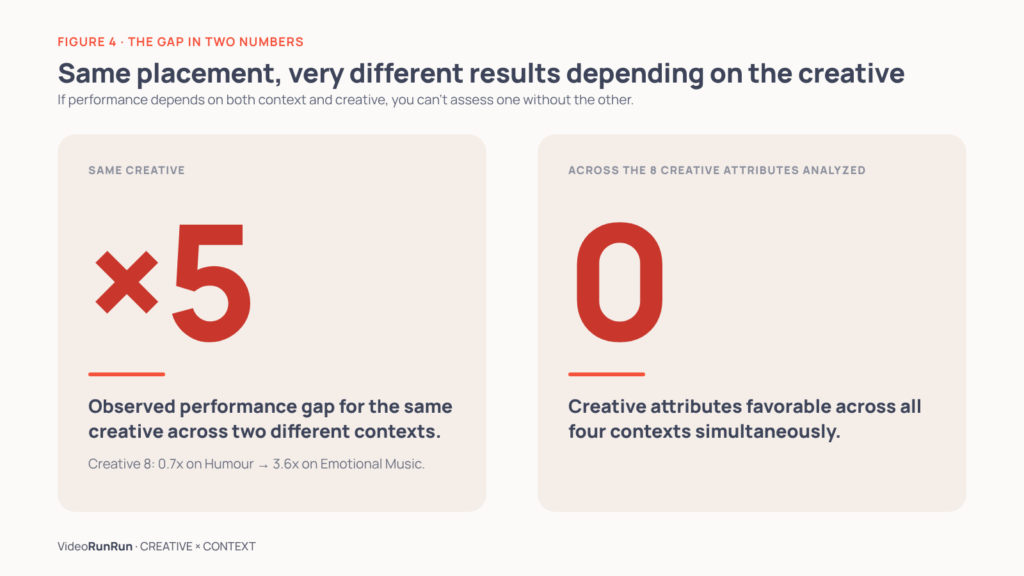
Two consequences for inventory sellers
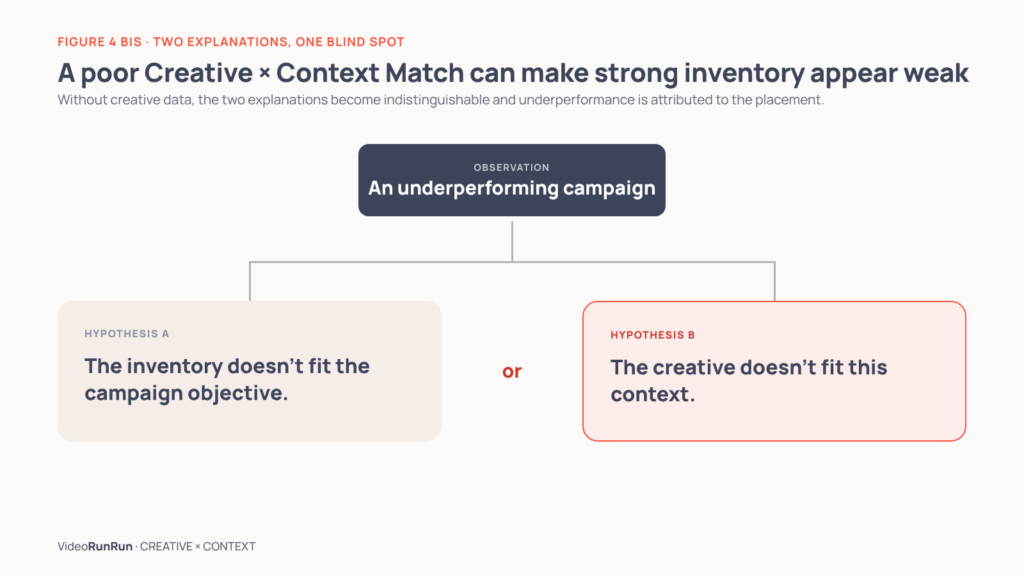
Without creative data, these explanations become difficult to distinguish.
A poor Creative × Context Match can make strong inventory appear weak.
This is why creative qualification should become part of how inventory performance is assessed, rather than remaining an additional campaign analysis.
Creative signals provide the missing variable needed to explain performance gaps and better assess the value of video inventory.
A continuous feedback architecture designed to increase the impact of the inventory sold.
Before activation, Pre-Flight assesses how well a creative matches a given context.
After activation, Post-Flight measures the performance of the Creative × Context combination actually served. These insights then feed back into the next Pre-Flight assessment.
The process follows four steps. Each campaign generates new data that makes the next one smarter.
Click “Run the loop” or any step, then cycle through campaigns to watch each Post-Flight tighten the Pre-Flight ranges and sharpen where the ad runs.
One thing is essential: accurately tracking each creative and inventory. Without this level of granularity, performance cannot be attributed to the right Creative × Placement Match, and the feedback loop cannot deliver meaningful insights.
Let’s use creative signals to dynamically assess the value of your contextual media plans or video inventory.
The four rules identified in our study are based on one advertiser, one industry vertical and one platform. The next step is to extend this approach to other types of video inventory.
The study protocol can be replicated across any advertiser (or multiple advertisers) and any video inventory, using a dataset of around ten creatives served across at least two distinct contexts.
This approach could enable ad managers and contextual inventory sellers to introduce dynamic inventory valuation, based on the attributes of the creatives being served.
Creative signals become a data layer for inventory valuation and optimization, rather than simply another asset uploaded at the last minute before campaign launch.
The study is based on highly granular data extracted from a performance-driven YouTube InStream campaign, with enough different video creatives running simultaneously to enable meaningful comparisons.
A study conducted by VideoRunRun’s Creative Intelligence team.
Fabrice Courdesses, CEO & Co-Founder
Loïc Ledu, Data Creative Strategist
Lambert Longuere, Video Campaign Manager
