
[contact-form-7 404 "Not Found"]
 Go back to Blog

Yannick Wittenauer
Published on 5 January 2026

Lunii is a leading French children’s audio brand, known for The Story Factory — a screen-free audio device that lets kids create and listen to personalized stories.
It’s a product designed for parents, consumed in the living room, and powered by both a device and a subscription model.
CTV is, on paper, a perfect environment for Lunii growth.
VideoRunRun’s mission was to reveal something deeper:
what creative patterns actually drive outcome-based action on the big screen.
By operating this campaign on YouTube CTV, VideoRunRun could identify what traditional TV never reveals: how each creative structure drives real post-view behaviours and which creative signals transform new prospects (new viewers) into visits, interest, and purchase.
To understand how CTV actually drives interest and purchase, VideoRunRun avoided the classic “one hero film” approach. Instead, we built a structured creative setup with:
Each format was analysed based on its performance during all the viewer progress, from view to purchase.
Instead of relying on unskippable CTV formats that artificially inflate view rates, VideoRunRun deliberately chose the skippable in-stream CTV format.
This choice introduces a real viewer decision — stay or skip — making the View Rate a meaningful signal, not a forced view.
We refer to this as Qualitative Attention: attention that is earned by the creative itself and can therefore be analysed, compared, and last by not least, optimised.
Qualified visits are defined as sessions lasting at least 15 seconds on the site — in other words, visits excluding bounce traffic.
CTV — like traditional TV — does not generate massive instant reactions. Its impact unfolds over time. To capture this lag effect, VideoRunRun analysed conversions over a 28-day post-view window, rather than focusing only on short-term or last-click metrics.
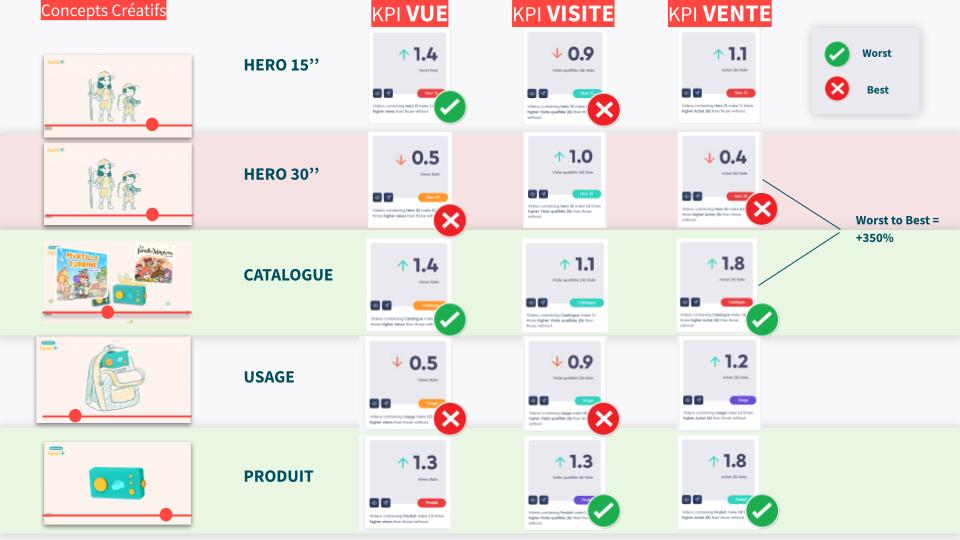
Each score shown on the slide is a ratio versus a baseline, not an absolute metric.
A score of 1.0 represents the average performance across all CTV creatives.
A score above 1.0 means the format performs proportionally better than average,
while a score below 1.0 means it underperforms.
This makes it possible to directly compare creative structures and understand which ones truly drive views, visits, and sales on CTV.
So, what does CTV creative really drive for Lunii? (KPI by KPI)
KPI
What we measured
What data shows
Key learnings
KPI #1 – Qualitative Attention (VTR)
View Rate on skippable in-stream CTV
×1.4 vs ×0.5 between Best and Worst formats
→ +180% VTR improvement
– Creative concept and structure is the primary qualitative attention driver.
– Immediate clarity beats storytelling in attention.
– Formats that fail to hold a qualitative attention almost never recover on sales.
KPI #2 – Qualified Visits (28d)
Post-view visits over 28 days
Results close to baseline across all creative concepts – yet sales outcomes tell a very different story.
– Visits reflect curiosity, not decision-making.
– QV is Not a KPI to pilot for Brandformance.
KPI #3 – Sales (28d)
Post-view purchases over 28 days
×1.8 vs ×0.4 between best and worst concepts and formats
→ +350% improvement
– Creative concept and structure is the dominant sales driver on CTV. Choosing the wrong creative concept and structure can divide sales by more than 4 — even within the same media setup, targeting, and budget.
– Sales performance is not correlated with format “status” or production value. It’s not driven from the most “TV-like” or narrative formats.
When media optimization usually increases ROAS by 10% to 40%, we can clearly see here that, even on the TV screen, the Creative can increase almost 400% the ROAS.
This campaign on YouTube CTV makes two things clear:
1/ CTV can generate measurable sales and
2/ investing in the best data prooved creative can multiply sales by 4.
Now that these patterns have been identified on YouTube CTV — with full measurement, granularity, and post-view analysis — the next step is obvious: deploying these learnings across premium CTV streaming environments.
No more waste with media spend.
Nor more attention that doesn’t drive action.
Welcome creative optimization for immediate outcome impact.
Curious to see what Creative Intelligence could reveal about your CTV campaigns?
Book a call with our team.

 Read more