In short
Creative is now recognized as the biggest driver of ad performance yet most teams still measure it by opinion, not by data.
The market rushed to Attention. It’s easy to measure. But all attentions are not equal: a well-targeted viewer can watch closely and still feel nothing that moves them to act.
What bridges a good impression into intent is the creative itself with specific, measurable signals.
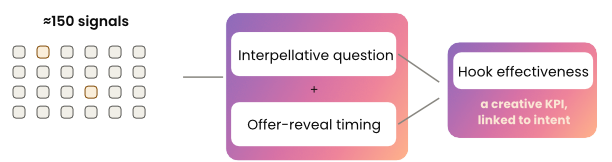
A single video contains ~150 creative signals. A Creative KPI is a recurring combination of them, correlated with a specific brand business outcome.
The performance conversation has a blind spot
Cannes Lions 2026 settled a long-running debate: creativity is the single biggest driver of advertising performance. Industry research now backs the intuition: creative optimization ranks as the top priority for teams improving effectiveness today.
But there’s a follow-up question almost nobody answers cleanly: if creative drives performance, how exactly are you measuring it?
That gap is the most expensive blind spot in marketing.
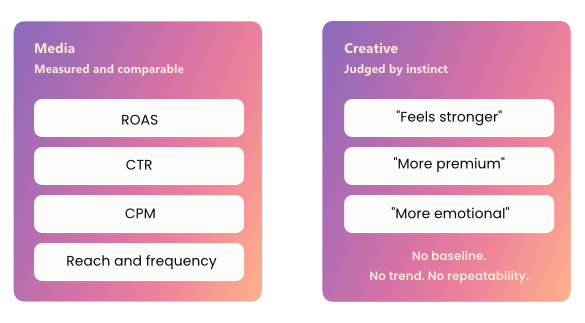
Media has KPIs. Creative has opinions.
Media speaks in numbers. Creative speaks in adjectives.
Every media review runs on a shared, defensible language: ROAS, CTR, CPM, reach, frequency.
Every creative review runs on instinct: “this version feels stronger,” “this one’s more premium.”
Useful, but not data: nothing you can benchmark against last quarter.
Two campaigns with identical targeting, budget, and placements can deliver completely different results. The honest explanation is usually the creative, the one variable nobody can attach a number to.
Real question is about whether your creative decisioning stays anecdotal forever or starts compounding, the way media optimization did once it adopted real metrics a decade ago.
Why now: AI removed the production bottleneck
For most of digital advertising’s history, the limit on creative was production capacity. That limit is gone.
Generating variants, testing intros, localizing cuts. None of it requires the cycles it used to. The bottleneck has moved.
The hard problem is no longer creating more content. It’s knowing what to keep, what to kill, and why, at the speed AI now produces.
Without a measurement layer, more creative just means more noise, faster, which may also deprecate brand image and overwhelm marketing teams.
Attention is the first level. Intent is the core one.
The market already solved audience quality.
Mid-funnel buying now reliably puts brands in front of intentionists, through data signals refined over a decade.
The “who to reach” problem is largely handled.
So the industry turned to the next made-easy-to-measure thing: Attention.
Eye-tracking, synthetic panels, gaze prediction … All quantifying whether someone is looking.
But not all attention is equal, even inside a qualified audience.
- There’s attention that registers a brand, at a passive, awareness-level.
- And there’s attention that activates purchase intent, where something in the creative flips “Didn’t know this product/brand” into “I want/need this.” From “Nice-to-have one day” to “Must-have today” as we say it in AdTech.
Same impression, same targeting, same spend => different outcome and ROAS, depending entirely on the video creative details.
The catch: most teams don’t know which elements those are.
So the bridge gets built by accident, or not at all.
That’s the gap we work in: identifying which creative signals activate intent, and making sure they’re present before launch, during the flight, or carried into the next production cycle.
From creative signals to Creative KPIs
To know what activates intent, you have to look at what the video actually does, frame by frame.
A single video holds roughly 150 distinct creative signals: who appears and when, how soon a voice speaks, how the product is framed, where the CTA sits, how the narrative paces, which emotions are leveraged.
A Creative KPI isn’t one signal in isolation, it’s a specific, recurring combination of signals correlated with a business outcome.
Take Hook Effectiveness. In one revealing pattern, it came less from putting a face on screen than from how the opening was built.
This is deliberately not a fixed checklist of universal metrics. The winning combination for one brand, category, or audience won’t be the winning combination for another.
What this means for marketing teams
The shift is about whether creative finally joins the conversation media has had for years, tracked, benchmarked, treated as a performance lever rather than a one-off bet on instinct.
Want to see what your own video assets reveal? Book a demo and find out what’s actually driving, or holding back, your performance.


 Go back to Blog