Why programmatic CTV still misses the mid-market
The prevailing explanations typically point to creative limitations or budget constraints.
That is not what we see among Mid-Market advertisers.
These brands know how to invest in video production, supported by years of operational maturity on Meta and YouTube.
What they lack is not creativity or budget, but the ability to activate the TV screen with the same digital reflexes they apply elsewhere.
Yet the market response often misses the mark, offering self-serve CTV tools built around €2,000 entry budgets or promises of GenAI-driven video production.
What the Mid-Market is actually seeking is granularity, incrementality measurement, cross-platform visibility, and structured guidance on creative decision-making.
Instead, CTV remains associated with three persistent blind spots:
- budgets perceived as rigid and difficult to scale progressively;
- platforms seen as complex and hard to internalise;
- and, above all, a Mid-Funnel that has long remained invisible within attribution models.
This was true of linear TV.
It no longer true for programmatic CTV.
And yet, CTV is still largely perceived as a branding cost — not as a short-term performance accelerator within a 30-day horizon.
CTV as a Funnel Extension — Not “Another TV”
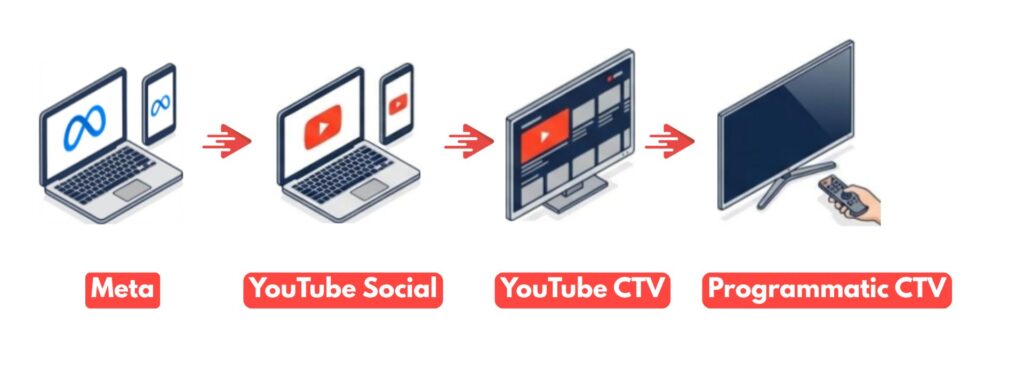
CTV should no longer be framed as a “new TV,” but as a natural extension of the performance funnel.
- Meta for activation and immediate impulse.
- YouTube for consideration.
- Programmatic CTV for depth, reassurance, and premium reinforcement.
Progressing from one stage to the next should not be a technological rupture, but a logical evolution of KPIs and measurement frameworks.
In the US, many Mid-Market advertisers have already made this shift.
Not because they operate with larger budgets, but because they have changed their analytical lens:
- moving away from last-click attribution;
- adopting incrementality and MMM approaches to assess impact beyond a 7 day window;
- scaling progressively through geo-based and creative testing, followed by budget tiers;
- and implementing genuine cross-platform measurement outside walled gardens.
With this mindset, CTV is no longer a break from performance.
It becomes a natural extension of the performance funnel — strengthening the Mid-Funnel to expand market share, while improving Bottom-Funnel efficiency.
What Advertisers Need to Change
This approach requires brands to move beyond a purely walled-garden view of performance, to adopt a genuinely integrated brandformance model, and — most critically — to properly equip Mid-Funnel measurement.
This is precisely how we support our clients at VideoRunRun in structuring and scaling their progression.


 Go back to Blog


 Read more