
[contact-form-7 404 "Not Found"]
 Go back to Blog

Yannick Wittenauer
Published on 24 February 2026

Engie is one of Europe’s leading energy providers — with strong commitments to green electricity and sustainable living. To bring that promise to life, Publicis Conseil imagined a series of brand-driven videos promoting Engie’s 100% green electricity offer — designed to raise awareness and spark attention.
ENGIE launched its “Green Electricity” summer campaign on Meta with a clear objective: acquisition.
Before activation, Publicis Conseil asked a simple question:
Are these videos structurally built to perform on Meta?
In highly competitive acquisition environments, even strong campaigns plateau when creative structure isn’t optimized for the platform and KPI.
ENGIE and Publicis Conseil decided not to rely on post-launch testing alone.
They wanted clarity before scaling spend.
Before activation, VideoRunRun conducted a Creative Pre-Flight Audit on four video assets (for more details on this step, read this case).
Using our Creative Intelligence Layer, we assessed:
Rather than delivering a report, VideoRunRun provided within 48 hours:
Blue 449 (Publicis Media) then activated both optimized and non-optimized versions within the same acquisition framework on Meta.
The analysis compared VRR-optimized creatives versus non-optimized assets.
The outcome was clear:
Optimized creatives delivered nearly the same purchase volume with significantly less budget.
This was not a media effect. It was structural creative efficiency.
Beyond the lift, ENGIE requested a deeper post-flight analysis to understand WHY VRR-optimized videos outperformed others, answering questions like :
The data revealed clear structural patterns leading to the next perfect brief.
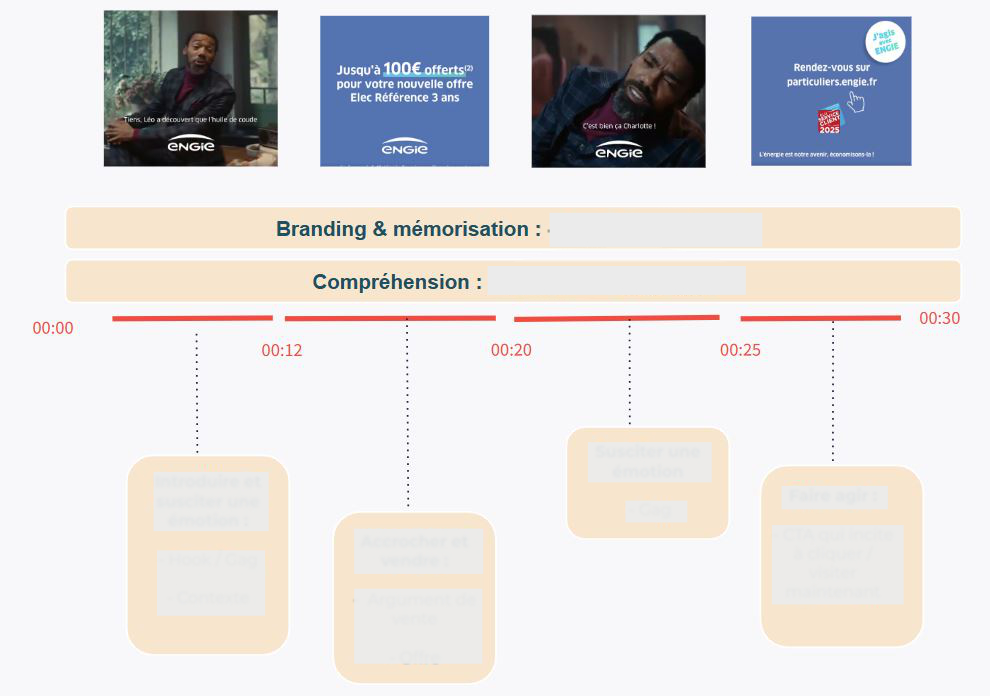
Performance was driven by how the message was introduced, developed and concluded.
Videos that built context before pushing the offer, framed the value proposition more explicitly and guided the viewer toward a clear action consistently delivered stronger efficiency.
In short, it wasn’t about producing more variations
— it was about structuring the narrative for conversion on each platform.
This case is not only about short term performance uplift.
It reflects a shift in posture across all three stakeholders:
ENGIE (advertiser), Publicis Conseil (creative agency) and Blue 449 (media agency).
Instead of treating video as a finished asset handed over to media, the teams aligned early around one shared question:
How do we structurally design creative for performance?
They built a continuous loop between production, media activation and data analysis.
Creative stopped being a black box passed between silos: It became a shared performance variable.
Most campaigns optimize spend only.
ENGIE optimized spend AND creative structure.
Media and Creative performance became explainable
Budget allocation and optimization became more efficient
Creative learning became cumulative
This is what a Creative Intelligence Layer before/during/after campaigns enables:
Not just better one-shot campaigns but Smarter unsiloted operating models campaign after campaign.
Let’s talk Creative Intelligence.
Book a call with our team.

 Read more